
Work Streams
deep dives in four parallel sessions
During the afternoon session, you can join one of the four work streams Data Acquisition, Transfer Learning, Didactics or Automotive Suitability. The sessions will run in parallel and in each session you will hear four high class talks on the subject. Choose your topic to discuss with the experts!
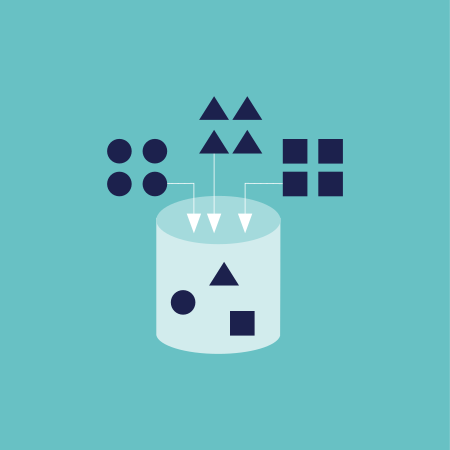
 The large amounts of collected and generated data
need a platform to facilitate data management and
processing. End users need insight into the content
to search and navigate through the data workflow to
further process the data. The next generation C.DATA
solution is a modular application that runs in a
browser and allows the user to manage data as well
as related workflows like fully automated annotation
and anonymization workflow for the recorded video
streams.
The large amounts of collected and generated data
need a platform to facilitate data management and
processing. End users need insight into the content
to search and navigate through the data workflow to
further process the data. The next generation C.DATA
solution is a modular application that runs in a
browser and allows the user to manage data as well
as related workflows like fully automated annotation
and anonymization workflow for the recorded video
streams.
 Simulations significantly ease the data elicitation
process since the desired conditions can be easily
set up. In addition to that, labels are provided for
free and do not need to be annotated by hand.
Overall, this results in an acceleration of the
algorithm research but synthetic data may also
increase the performance of models on real data. In
this talk, we present how the partners in KI Delta
Learning are using the open driving simulator CARLA
in order to generate synthetic data for the
different deltas in the project.
Simulations significantly ease the data elicitation
process since the desired conditions can be easily
set up. In addition to that, labels are provided for
free and do not need to be annotated by hand.
Overall, this results in an acceleration of the
algorithm research but synthetic data may also
increase the performance of models on real data. In
this talk, we present how the partners in KI Delta
Learning are using the open driving simulator CARLA
in order to generate synthetic data for the
different deltas in the project.
 Many datasets have been created in the area of
autonomous driving, but none of them satisfy the
demands in the area of domain adaptation. Creating
such a dataset is a challenging task. It requires a
certain number of labeled samples as well as
diversity regarding data types and tasks. This talk
names relevant aspects and discusses two technical
problems. On the one hand, only a subset will be
labeled manually. The question at hand is how to
select these samples. On the other hand, the rest of
the dataset may be labeled (semi-) automatically.
Many datasets have been created in the area of
autonomous driving, but none of them satisfy the
demands in the area of domain adaptation. Creating
such a dataset is a challenging task. It requires a
certain number of labeled samples as well as
diversity regarding data types and tasks. This talk
names relevant aspects and discusses two technical
problems. On the one hand, only a subset will be
labeled manually. The question at hand is how to
select these samples. On the other hand, the rest of
the dataset may be labeled (semi-) automatically.
 We present a way to perform an online style transfer
for continual domain adaptation which improves
performance on unseen target domains using a given
perception model. The approach is based on an image
style transfer in the frequency domain and requires
neither an adjustment of the given model parameters
to the target domain, nor does it require any
considerable amount of memory for storing its
frequency domain, considering the hardware
limitations in an autonomous vehicle.
We present a way to perform an online style transfer
for continual domain adaptation which improves
performance on unseen target domains using a given
perception model. The approach is based on an image
style transfer in the frequency domain and requires
neither an adjustment of the given model parameters
to the target domain, nor does it require any
considerable amount of memory for storing its
frequency domain, considering the hardware
limitations in an autonomous vehicle.
 We introduce a mixture of two expert models
specializing in high and low-frequency robustness,
respectively. Moreover, we propose a new
regularization scheme that minimizes the total
variation (TV) of convolution feature-maps to
increase high-frequency robustness. The approach
improves on corrupted images without degrading
in-distribution performance. We demonstrate this on
ImageNet-C and also for real-world corruptions on an
automotive dataset, both for object classification
and object detection.
We introduce a mixture of two expert models
specializing in high and low-frequency robustness,
respectively. Moreover, we propose a new
regularization scheme that minimizes the total
variation (TV) of convolution feature-maps to
increase high-frequency robustness. The approach
improves on corrupted images without degrading
in-distribution performance. We demonstrate this on
ImageNet-C and also for real-world corruptions on an
automotive dataset, both for object classification
and object detection.
 We evaluate knowledge graph neural networks on
different datasets. The results show that a visual
model trained with a knowledge graph as a trainer
outperforms a model trained with cross-entropy in
all experiments, in particular when the domain gap
increases. Besides a better performance and a
stronger robustness to domain shifts, these networks
can simultaneously adapt to multiple datasets and
classes without heavily suffering from catastrophic
forgetting.
We evaluate knowledge graph neural networks on
different datasets. The results show that a visual
model trained with a knowledge graph as a trainer
outperforms a model trained with cross-entropy in
all experiments, in particular when the domain gap
increases. Besides a better performance and a
stronger robustness to domain shifts, these networks
can simultaneously adapt to multiple datasets and
classes without heavily suffering from catastrophic
forgetting.
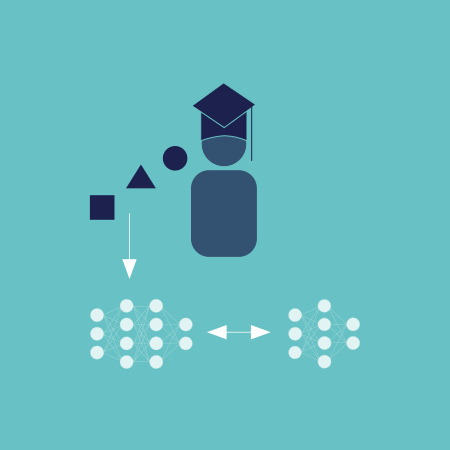
 Deep Learning requires a huge amount of training
data but labeled data is expensive. Unlabeled data
is available en masse. How can we reduce the
labeling costs by choosing the best (sub-)set for
labeling?
Deep Learning requires a huge amount of training
data but labeled data is expensive. Unlabeled data
is available en masse. How can we reduce the
labeling costs by choosing the best (sub-)set for
labeling?
 How to combine Semantic Self-Supervision and
Self-Training for Domain Adaptation in Semantic
Segmentation? A two-staged, unsupervised domain
adaptation process for semantic segmentation models
by combining a self-training and self-supervision
strategy.
How to combine Semantic Self-Supervision and
Self-Training for Domain Adaptation in Semantic
Segmentation? A two-staged, unsupervised domain
adaptation process for semantic segmentation models
by combining a self-training and self-supervision
strategy.
 Schulik Thomas, ZF
and
Frederik Blank, Bosch
will talk on Ontology- and scenario-based
testing, which is illustrated using NCAP-like
scenarios and a test methodology.
Schulik Thomas, ZF
and
Frederik Blank, Bosch
will talk on Ontology- and scenario-based
testing, which is illustrated using NCAP-like
scenarios and a test methodology.
 Depth estimation is an important component of
autonomous driving and should function robustly in
case of domain shifts or previously unseen objects.
We evaluate existing methods regarding cross-domain
performance and present a method that is trained
only on randomized synthetic data and functions
better in this setting, as it rather relies on the
motion parallax between multiple images, than on
domain-specific single-view depth priors.
Depth estimation is an important component of
autonomous driving and should function robustly in
case of domain shifts or previously unseen objects.
We evaluate existing methods regarding cross-domain
performance and present a method that is trained
only on randomized synthetic data and functions
better in this setting, as it rather relies on the
motion parallax between multiple images, than on
domain-specific single-view depth priors.
 Autonomous cars will sooner or later incur novel or
insecure situations, where risk minimizing
strategies have to be applied to solve these
situations. This work shows methodologies to
automatically detect abnormal interactions between
road users in order to trigger such defensive
strategies.
Autonomous cars will sooner or later incur novel or
insecure situations, where risk minimizing
strategies have to be applied to solve these
situations. This work shows methodologies to
automatically detect abnormal interactions between
road users in order to trigger such defensive
strategies.
 In order to design embedded AI systems, the hardware
requirements and limitations should be considered
from the very first step. This work thus presents a
methodology to determine the to-be-expected hardware
execution times from an analysis of the general AI
topology. Before even training an AI, the hardware
compitability can thus be made sure.
In order to design embedded AI systems, the hardware
requirements and limitations should be considered
from the very first step. This work thus presents a
methodology to determine the to-be-expected hardware
execution times from an analysis of the general AI
topology. Before even training an AI, the hardware
compitability can thus be made sure.
 Several optimization techniques exist to adapt the
topology of an existing, pre-trained AI onto the
requirements of the hardware. Most such work does
optimize for general, available parameters such as
number of operations or number of parameters. In
this work, we present how to actually regard
relevant hardware metrics and how to succesfully
combine several optimization methodologies into a
hardware aware optimization.
Several optimization techniques exist to adapt the
topology of an existing, pre-trained AI onto the
requirements of the hardware. Most such work does
optimize for general, available parameters such as
number of operations or number of parameters. In
this work, we present how to actually regard
relevant hardware metrics and how to succesfully
combine several optimization methodologies into a
hardware aware optimization.